
Lifewater Canada
Lifewater Canada

|

|
Build Your Own Water Level and TDS Sensor
One of the challenges in drilling wells is finding the depth of the water, the water recovery rate and the quality of the water. Normally, two measuring devices are used. One, an Electric Water Level Tape, and the other, a TDS or Total Dissolved Solids Meter are used. Both are very expensive instruments which use fragile electric meter movements to detect electric current. The challenge facing those drilling wells in third world countries is to have something that does the same thing in an inexpensive rugged instrument.
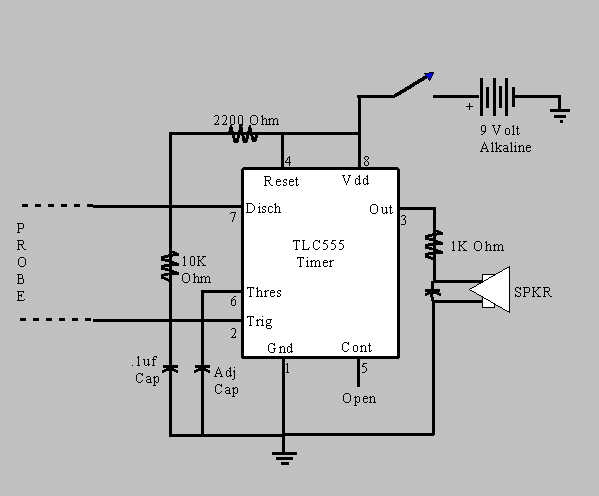
One option is to build an
astable multivibrator using
a TLC555 timer. This timer is ideal because of its extremely
low power
consumption. The circuit can be built right into an older
style telephone
handset with all components (probe excepted) included in the
handset .
The circuit works by sensing the resistance of the probe. If
the probe
is open (not touching water) the circuit will produce an audio
frequency
around 400 hz. When the probe touches quality water, the
frequency
doubles (approximately) increasing the tone by about one
octave. If
the water has dissolved solids in solution, the tone will
quickly go
higher giving the person measuring an approximation of the mineral
quality
of the water. A fairly high note, nearing a squeal would
indicate the
detection of brine or extremely high levels of hardness etc.
If, for
some reason the probe shorts, the circuit will produce a very high
pitched
whistle that will not change when the probe comes in contact with
water.
Though this circuit does give a approximate estimate of the hardness of
water,
it will not give a good estimate of the SAFETY of the water.
For a
further explanation of its limitations, please go to
Frequently Asked
Questions
.
The circuit works by sensing the resistance of the probe. If
the probe
is open (not touching water) the circuit will produce an audio
frequency
around 400 hz. When the probe touches quality water, the
frequency
doubles (approximately) increasing the tone by about one
octave. If
the water has dissolved solids in solution, the tone will
quickly go
higher giving the person measuring an approximation of the mineral
quality
of the water. A fairly high note, nearing a squeal would
indicate the
detection of brine or extremely high levels of hardness etc.
If, for
some reason the probe shorts, the circuit will produce a very high
pitched
whistle that will not change when the probe comes in contact with
water.
Though this circuit does give a approximate estimate of the hardness of
water,
it will not give a good estimate of the SAFETY of the water.
For a
further explanation of its limitations, please go to
Frequently Asked
Questions
(If you go to a picture, or diagram via a link or camera, just hit your Back Button to return to the place you came from.)
The circuit once attached
will fit nicely under the
speaker with the speaker unit in place. A miniature momentary
push
button switch should be used between the 9V Alkaline battery and the
circuit.
This ensures that the unit cannot accidentally be left in the on
position.
The switch is best mounted near the ear speaker where it can be easily
depressed
by the thumb or index finger. The battery can then be
installed where
the microphone and microphone socket were installed.
The probe wires can exit
out of the original curly
cord inlet. Once the wires are installed, this hole should be
sealed
with silicone (Do NOT use Mono as a sealant since it has electrical
properties
that enable the flow of current which messes up the reliability of the
circuit.) The probe wire can be from 50' - 500'. In
our first
model, we used standard 24 gauge speaker wire because of its
flexibility,
size and price. 100' of probe speaker wire can nicely be
wrapped around
a piece of wood siliconed to the back of the handset for easy storage
and
portability.
A round non porous rock, approximately 1" in diameter works well as a
weight
for the
probe.
Using a little silicone and an elastic band will attach the wire to the
rock. Make sure that you do not cover the tinned wire ends
with
silicone.
|
|
||
| Quantity |
|
|
|
|
Northern Electric Style G3 Telephone Handset with ear and mouth covers | |
|
|
HHMR-80V(U-1) Receiver Unit, Diode must be
Removed (clip it off if necessary)
Other possible part numbers (1182, ?) |
|
|
|
1/4" Long Connecting Screws for the above Receiver. These will be used to mount and connect the circuit board to the receiver unit. If you have an older reciever unit, 1/4" screws will already be on the reciever. If however you have a newer unit, 1/4" screws will have to be obtained since the included 1/8" screws are not long enough. | |
|
|
#12 lock washers to improve the connection between the receiver and prevent shorts on the foil side of the circuit board. | |
|
|
Momentary On Push Button Switch (i.e.. push to talk switch, the smaller the better) The quality of this switch is essential since it is the one moving part in the entire unit. | |
|
|
100' (or more) 24 gauge multi-stranded or braided speaker wire (flexibility, size and durability are essential considerations) | |
|
|
Water Sensor Printed Circuit Board (make it if you have the resources, skills and equipment, or order it directly from us. Mask information is included below if you choose to make your own circuit board) | |
|
|
TLC 555 Timer | |
|
|
10K Ohm Resistor (brown-black-orange) 1/4 or 1/8th watt | |
|
|
1K Ohm Resistor (brown-black-red) 1/4 watt | |
|
|
2.2K Ohm Resistor (red-red-red) 1/4 or 1/8th watt | |
|
|
.1uF capacitor | |
|
|
1 foot black stranded internal connecting wire | |
|
|
1 foot red stranded internal connecting wire | |
|
|
9V Battery Connector | |
|
|
9V Alkaline Battery | |
| Tub and Tile Silicone Sealant | ||
|
|
Wooden Wire holder shaped as pictured below made to fit the back side of the telephone hand set. | |
|
|
General Purpose Elastic Bands | |
|
|
Round Rock 1" | |
|
|
A.
Obtain the "Well Sensor Printed Circuit Board" and proceed to install
the parts as shown in the graphic immediately below. This
view has the copper foil on the bottom side. All parts should
be installed right on the circuit board without extra lead
length. This encourages ruggedness.
B. Turn the printed circuit board over, carefully place it in a small vice to keep it secure and solder the components onto the board. Because of the size of this circuit, it is recommended that a person with electronics experience do this task. Overheating can damage the circuit board or its components. Under heating can cause the solder to bead and make a poor connection. Quality soldering equipment makes a world of difference! A site that shows and teaches you how to solder is http://www.epemag.wimborne.co.uk/solderpix.htm Once the parts have been properly soldered in position, clip off any excess lead length, as close to the circuit board as possible without clipping the actual soldering itself. Clipping the soldering can break the solder bond between the lead and the foil. Leaving the leads too long will cause the unit to short once it is mounted on the back of the receiver. |

R1
= 1000
Ohms
C1 = .1uF |
|
|
|
|
|
|
|

The probe can be weighted with a 1 inch marble or even a simple non porous rock, tied between the leads with an elastic band or siliconed between the leads. If you happen to loose the rock, replacements should not be hard to come by! |
|
|
| Put your well water sensor to the side. Find
a piece of wood approximately 1" wide. If you use lighter
wood, it is easier to cut and shipping costs less!
Cut it to the shape shown below. You may want to use the template
provided below. Print it out, it should print out to the
right dimensions. Once you have cut it out, sanded and or
finished it to your pleasure, silicon it to the back of the
handset. Let the silicone cure. Once the storage block is
secure, carefully wrap the well water probe wire around it. Want to
Print out the block we made to scale - Click
here to Go to WoodBlock Diagram |
|
|
|
|
|
The advantage of using musical tones for the purpose
sensing water and water quality is that musical tones are understood
throughout the world. This Well Water and TDS sensor can be
relatively calibrated very simply. The procedure for
calibration is follows:
|
|
|
| This circuit board
is designed to be mounted directly to the back of a standard telephone
speaker (with the original diode removed). The exact distance
from center to center of the mounting holes should be 15/16".
Accurately scaled 1-1 and 2-1 positive and negative foil photo masks
are linked below. When mounted on the back of the speaker,
the foil side of the circuit board should be toward the speaker for
purposes of contact with the speaker contacts. Lock washers
should be between the circuit board and the speaker contact to provide
spacing and better contact.
Under this color diagram are links to accurately scaled 1-1 and 2-1 positive and negative foil photo masks that should print out in exact dimensions. |
 |
|
|
|
|
|
|
|
|
|
|
|
|
|
|
 |
| "The TLC555 is a
monolithic timing circuit fabricated using the Lin-CMOS*
process. Due to its high impedance inputs (typically 1012
Ohms), it is capable of producing accurate time delays and oscillations
while using less expensive, smaller timing capacitors then the
NE555. Like the NE555, the TLC555 achieves both mono stable
(using one resistor and one capacitor and astable (using two resistors
and one capacitor) operation. In addition, 50% duty cycle
astable operation is possible using only a single resistor and one
capacitor. It operates at frequencies up to 2 Mhz and is
fully compatible with CMOS, TTL, and MOS logic. It also
provides very low power consumption (typically 1 mW at VDD
= 5V) over a wide range of supply voltages ranging from 2 volts to 18
volts.
Like the NE555, the threshold and trigger levels are normally two thirds and one third respectively of VDD. These levels can be altered by use of the control voltage terminal. When the trigger input falls below trigger level, the flip-flop is set and the output goes high. If the trigger input is above the trigger level and the threshold input is above the threshold level, the flip-flop is reset and the output is low. The reset input can override all other inputs and can be used to initiate a new timing cycle. When the reset input goes low, the flip-flop is reset and the output goes low. Whenever the output is low, a low impedance path is provided between the discharge terminal and ground. While the complementary CMOS output is capable of sinking over 100mA and sourcing over 10 mA, the TLC555 exhibits greatly reduced supply current spikes during output transitions. This minimizes the need for the large decoupling capacitors required by the NE555." |
Template for wooden block
|
Have Questions About this Unit - Email Me, I'll try answer them. |
|
|
| Response: The sensor's qualitative measure of Total Dissolved Solids (TDS) is a side bonus that has nothing to do with the safety of the water. TDS measures the presence of minerals such as calcium & magnesium (which determine the hardness of water), sulphate, chloride and alkalinity. Lifewater teaches and practices the use of pathoscreen (bacteria) and nitrate tests to routinely determine whether or not water is safe to drink. The qualitative TDS capability of the electric water level tape will be usefull when drilling near the ocean since it will give a rough indication whether or not high salt may be present in the water. This will help drillers decide whether to spend extra money and complete the well, or whether a certain water bearing vein needs to be blocked off etc. The presence of sodium chloride (salt) does not make the water unsafe to drink, but can give it an unpleasant taste and cause premature corrosion of certain pump parts. |


